Quick Answer
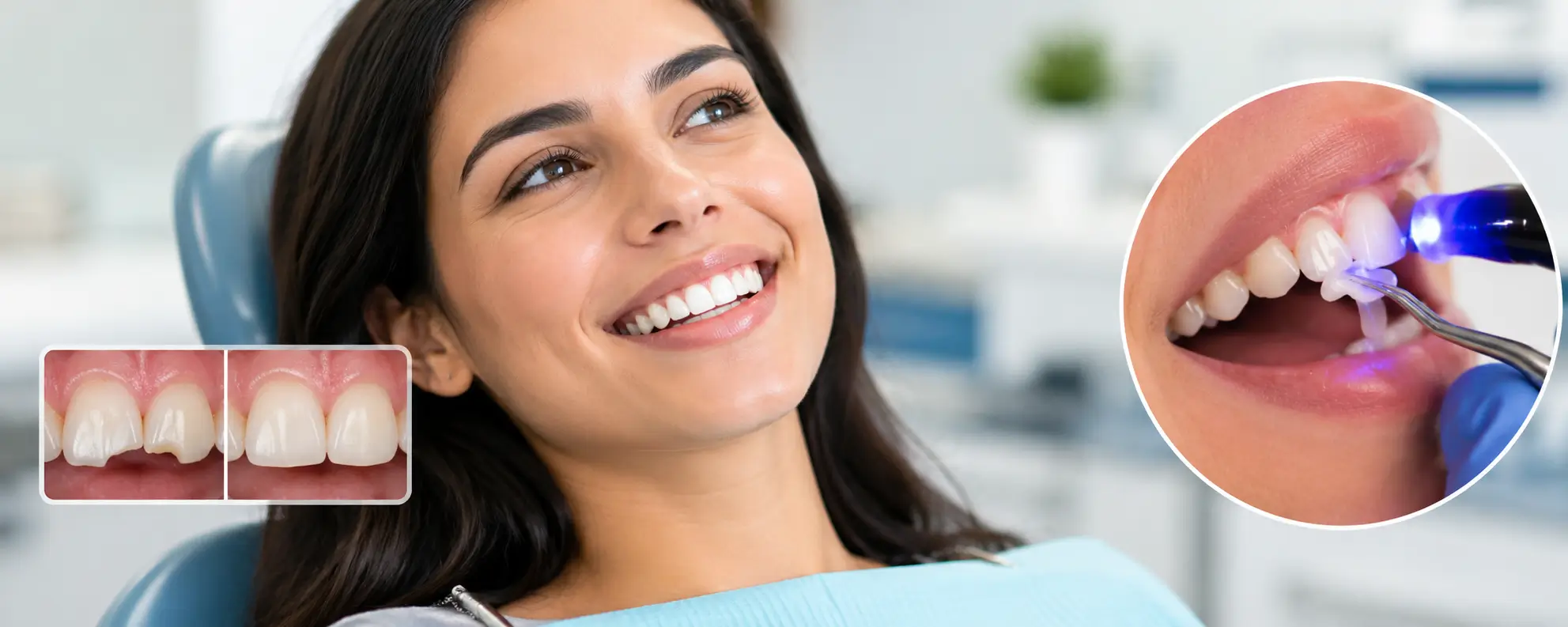
Teeth bonding, also called composite or dental bonding, is a cosmetic treatment where a dentist applies tooth-coloured resin to a tooth, shapes it and hardens it with a light. It repairs chips, closes small gaps and reshapes uneven teeth, usually in one visit.
Teeth bonding can fix a small flaw in one visit. If you have a chipped edge, a narrow gap or a tooth that looks shorter or more uneven than its neighbours, bonding is one of the least invasive ways to change it. At Walton Dental Surgery in Walton-on-Thames, composite bonding starts from £275.
This guide covers what bonding is, what it can and cannot fix, what happens at the appointment, how long it lasts, what it costs in the UK and how to pick a dentist who does it well. We include the downsides because you should hear them before you book. We see patients from Walton-on-Thames, Hersham, Esher, Shepperton and Weybridge.
| Question | Short answer |
|---|---|
| What it is | Tooth-coloured resin shaped onto the tooth and set with a blue light |
| Best for | Chips, small gaps, uneven edges, slightly short or misshapen teeth |
| Time | Usually one visit. Allow about 30 to 60 minutes per tooth |
| Anaesthetic | Often not needed |
| How long it lasts | Often 5 to 10 years. Less with grinding or heavy staining |
| Cost here | From £275 at Walton Dental Surgery |
| On the NHS? | No. NHS care does not cover cosmetic treatment |
| Main downsides | Stains and chips more easily than porcelain. Needs polishing and repair over time |
What is teeth bonding?
Teeth bonding is a cosmetic treatment where a dentist adds tooth-coloured resin to a tooth, shapes it by hand and sets it with a blue light. The dentist then polishes the resin until it blends with the teeth around it. You will also see it called dental bonding or composite bonding. All three names mean the same treatment.
The dentist matches the resin to the shade of your natural teeth. They add material to the tooth instead of cutting the tooth away, so bonding is one of the least invasive cosmetic options. Many cases need only a light roughening of the surface so the resin can grip. Local anaesthetic is often not needed unless the tooth is sensitive or has decay.
Is bonding the same as a composite filling? The material is similar. The purpose differs. A filling repairs decay. Bonding changes how a tooth looks. Some clinics use the term composite veneers when the resin covers the whole front of a tooth. If you want to replace old silver fillings instead, see our white fillings page.
What can teeth bonding fix?
- Chipped teeth: rebuilds a broken corner or edge, most often on the front teeth.
- Small gaps: closes a narrow space between two teeth.
- Uneven or worn edges: smooths a jagged or flattened edge.
- Short teeth: adds length so the smile looks balanced.
- Misshapen teeth: improves a tooth that looks narrow, pointed or small.
- Some marks and stains: covers areas that whitening does not shift.
Bonding has limits. It does not suit heavy crowding, a colour change across every tooth or a tooth that has lost a large part of its structure. For bigger breaks, inlays and onlays or crowns often hold up better. A good dentist will tell you so instead of offering bonding by default. If a chipped tooth hurts, see our emergency dentist page.
Is composite bonding right for you?
Bonding tends to suit you if you have
- Healthy teeth and gums
- A small cosmetic goal, not a full smile redesign
- Enough natural tooth for the resin to grip
- Good daily cleaning habits
- Realistic expectations and a plan to keep up check-ups and polishing
Treat the cause first, or think twice, if you have
- Untreated decay or gum disease
- Heavy grinding or clenching that nobody has managed (dentists call this bruxism)
- Tooth wear from acid or grinding
- A bite problem
- Poor oral hygiene
What your dentist should check first
Before any bonding a good dentist looks at your gums, checks for decay, assesses wear, studies how your teeth meet and listens to what you want. They may take X-rays or photos so you can both see the plan. The General Dental Council (GDC) says problems with bonding often start with weak diagnosis, planning or consent. A thorough first visit is a good sign.
What happens during a teeth bonding appointment?
Most visits follow six steps.
- Check and plan. Your dentist examines your teeth and gums, listens to what you want to change and explains what is realistic.
- Shade match. A shade guide picks the resin colour closest to your natural teeth.
- Prepare the tooth. The surface is lightly roughened and conditioned so the resin grips. Drilling is usually minimal or not needed.
- Apply and shape. The resin goes on in layers and is sculpted to the right length and contour.
- Set with light. A blue curing light hardens the resin within seconds.
- Polish and check your bite. Your dentist finishes the surface to a natural shine and checks that nothing feels high.
Allow about 30 to 60 minutes for each tooth. Treating several teeth takes longer. You can go back to normal activities straight away.
Some people feel that the tooth is bulkier or that their speech sounds different for a few days. Tell your dentist if this does not settle. A small adjustment fixes most cases.
Does teeth bonding hurt?
For most people no. Because preparation is minimal many patients have bonding without an injection. You may feel pressure or a brief twinge on a tooth that is already sensitive to cold. If you would feel more comfortable ask for local anaesthetic. Mild sensitivity can last a short while after treatment, and over-the-counter pain relief helps.
If dental visits make you anxious tell the team when you book. Our nervous patients page explains how we plan appointments around you.
The benefits and limits of bonding
What bonding does well
- Improves the shape, length and symmetry of a tooth
- Matches your natural shade closely
- Removes little or no tooth in most cases
- Finishes in one visit for many cases
- Costs less than porcelain alternatives
- Often allows repair or a top-up if the resin chips
Where bonding falls short
- It stains. Composite is more porous than enamel. Coffee, tea, red wine, smoking and strong spices such as turmeric can mark it.
- It loses shine. Polishing at check-ups brings the surface back.
- It wears and chips. Biting edges take the most strain.
- It can fail. The resin can come away from the tooth, or decay can start at the edge.
- It needs upkeep. Expect polishing, repair or replacement over its lifetime.
None of this makes bonding a poor choice. It means you should know the upkeep before you start.
Is teeth bonding reversible?
You will often read that bonding is reversible. The honest answer is more careful. A dentist can remove composite. Taking all of it off without touching the enamel underneath is hard, and the GDC warns against describing bonding as simple or risk free. Treat bonding as a long-term choice that needs upkeep. Ask your dentist what removal would involve for your tooth before you agree to treatment.
How long does composite bonding last?
Bonding is not permanent. Many dentists quote 5 to 10 years. The Cleveland Clinic gives a wider range of 3 to 10 years. Your own result sits somewhere in that range, and your dentist can tell you what is realistic for your mouth.
These factors change how long it lasts:
- Cleaning: regular brushing, flossing and check-ups keep the edges of the resin healthy.
- Diet: frequent tea, coffee, red wine and smoking stain composite over time.
- Grinding or clenching: extra force shortens its life.
- Habits: biting nails, pen lids or ice chips the resin.
- Which tooth: front biting edges take more strain than a tooth surface under no load.
- How much resin: small repairs usually last longer than large reshaping.
Ask what a repair costs and whether any guarantee applies before you start. Clear terms in writing avoid surprises later.
Composite bonding vs veneers
This is the most common comparison. Neither option wins every time. The right choice depends on what you want to change.
| Factor | Composite bonding | Porcelain veneers |
|---|---|---|
| Material | Tooth-coloured composite resin | Porcelain shell |
| Tooth preparation | Usually minimal | Usually some enamel removal |
| Visits | Often one | Usually more than one |
| Best for | Minor changes and repairs | Bigger cosmetic changes |
| Stain resistance | More prone to staining | More stain resistant |
| Typical lifespan | Several years, often 5 to 10 | Often 10 to 20 years |
| Can it be undone? | Can be removed, but not risk free | No, because enamel is removed |
| Cost | Generally lower | Generally higher |
| On the NHS? | Not for cosmetic use | Not for cosmetic use |
Teeth bonding vs clear aligners and whitening
The treatments solve different problems. Bonding changes the shape of a tooth. Aligners such as Invisalign move teeth into a new position. Bonding can close a small gap by eye in one visit. If the gap exists because teeth are crooked or spread across the arch, moving them often looks more natural. Some patients combine both. Aligners come first to position the teeth. A little bonding then fine-tunes the finish. For a shorter route to straighter-looking front teeth, ask about Six Month Smiles. If you also want whiter teeth, whiten first. Whitening does not change the colour of composite, so your dentist matches the resin to your new shade. See our teeth whitening page. Many patients bring these treatments together in a smile makeover.How much does teeth bonding cost in the UK?
At Walton Dental Surgery composite bonding starts from £275. The final cost depends on your case, so treat the starting price as a guide. These factors change the cost:- How many teeth you treat
- How much resin each tooth needs
- How complex the reshaping is
- The position of the tooth in your mouth
- Whether existing fillings or restorations are involved
- Whether other dental work needs to come first
Is teeth bonding available on the NHS?
No. NHS.uk states that cosmetic treatments to change how your teeth look are not available on the NHS. NHS care covers treatment you need for your oral health. Bonding for appearance is a private treatment. See our pricing page for current prices, and ask whether our dental plan suits your needs. Ask what any quote includes. Check whether it covers the consultation, X-rays, polishing visits and repairs. A low headline price can hide extra charges.Ready to find out if bonding suits you?
Book a bonding assessment at Walton Dental Surgery. Book online or call 01932 225748.
How to choose a teeth bonding dentist
Most concerns trace back to weak diagnosis, planning and consent. Use this checklist.
- Check the register. Search your dentist by name on the GDC register. Every dentist and dental therapist working in the UK must be on it.
- Expect a full examination first. That means a gum check, a decay check and a bite check. X-rays or photos where needed.
- Ask for a plan and a preview. Photos, a scan or a mock-up help you agree what the result will look like.
- Ask about upkeep in plain words. Staining, polishing, repair and replacement should all come up.
- Get costs and repair terms in writing. Include what repairs cost and what a guarantee covers.
- Value honesty. A dentist who tells you bonding is wrong for your teeth is protecting you.
You can meet our dentists on our team page.
How to look after bonded teeth
- Brush twice a day with a soft toothbrush and fluoride toothpaste.
- Clean between your teeth once a day.
- Keep up check-ups and hygiene visits so your dentist can check and polish the edges.
- Avoid biting nails, pen lids, packaging and ice.
- Cut back on staining drinks and foods, or rinse with water afterwards.
- Stop smoking if you smoke. It stains composite fast.
- Ask about a night guard if you grind or clench.
Call us if the tooth has a sharp edge, feels high when you bite or the bonding chips. These are quick fixes.
Teeth bonding in Walton-on-Thames and nearby
Walton Dental Surgery is at 71A Hersham Road, Walton-on-Thames KT12 1LL. Patients travel to us from Hersham, Esher, Shepperton and Weybridge. Call 01932 225748 or get in touch to book.
Frequently asked questions
What is teeth bonding?
Teeth bonding is a cosmetic treatment in which a dentist applies tooth-coloured resin to a tooth, shapes it and hardens it with a light to change its shape, size or look.
Is composite bonding the same as dental bonding?
Yes. Composite bonding, dental bonding and teeth bonding all describe resin bonded to the tooth surface.
How much does composite bonding cost in Walton-on-Thames?
At Walton Dental Surgery composite bonding starts from £275. The final price depends on how many teeth you treat and how much work each one needs.
Is teeth bonding available on the NHS?
No. Cosmetic treatment is not available on the NHS. Bonding for appearance is private.
How long does a bonding appointment take?
Allow about 30 to 60 minutes per tooth. Most patients finish in one visit.
Does composite bonding hurt?
Most people find it comfortable. Anaesthetic is often not needed, and your dentist can offer it if you are sensitive or nervous.
How long does composite bonding last?
Many dentists quote 5 to 10 years. Grinding, staining habits and biting hard objects can shorten that.
Can composite bonding fix chipped teeth?
Yes. Small to moderate chips are one of the most common reasons people choose bonding. Larger breaks may need an onlay or crown.
Can bonding close gaps between teeth?
Small gaps often close well. Larger gaps, or gaps caused by crowding elsewhere, may suit orthodontics better.
Is bonding better than veneers?
Neither wins every time. Bonding removes less tooth and costs less. Veneers last longer and resist stains better.
Does composite bonding stain?
Yes, more than porcelain. Coffee, tea, red wine, smoking and turmeric can mark it. Polishing at check-ups helps.
Can bonded teeth be whitened?
Whitening does not change composite. If you plan to whiten your natural teeth, do it first so the dentist matches the resin to the new shade.
Can composite bonding be removed?
A dentist can remove it. Removing all of it without touching the enamel underneath is hard, so treat bonding as a long-term choice. Ask what removal would involve for your tooth.
Can I eat normally after bonding?
Usually yes. You can return to normal activities straight away. Avoid biting very hard foods, ice and nails, and follow your dentist advice.
What if the bonding chips or comes off?
Contact the practice. A chip can often be repaired or polished. Ask about repair costs before treatment.
How do I know a bonding dentist is qualified?
Search their name on the GDC register and ask for a full examination, a written plan and costs before treatment starts.
Do you treat patients from outside Walton-on-Thames?
Yes. Many patients travel from Hersham, Esher, Shepperton, Weybridge and other parts of Surrey.
Thinking about teeth bonding? Start with an assessment
Not sure whether bonding, veneers or aligners suit your teeth? An assessment shows you which option fits your goals and budget before you commit to anything.
If you live in Walton-on-Thames or nearby in Hersham, Esher, Shepperton, Weybridge or elsewhere in Surrey, book an appointment with Walton Dental Surgery or call 01932 225748.