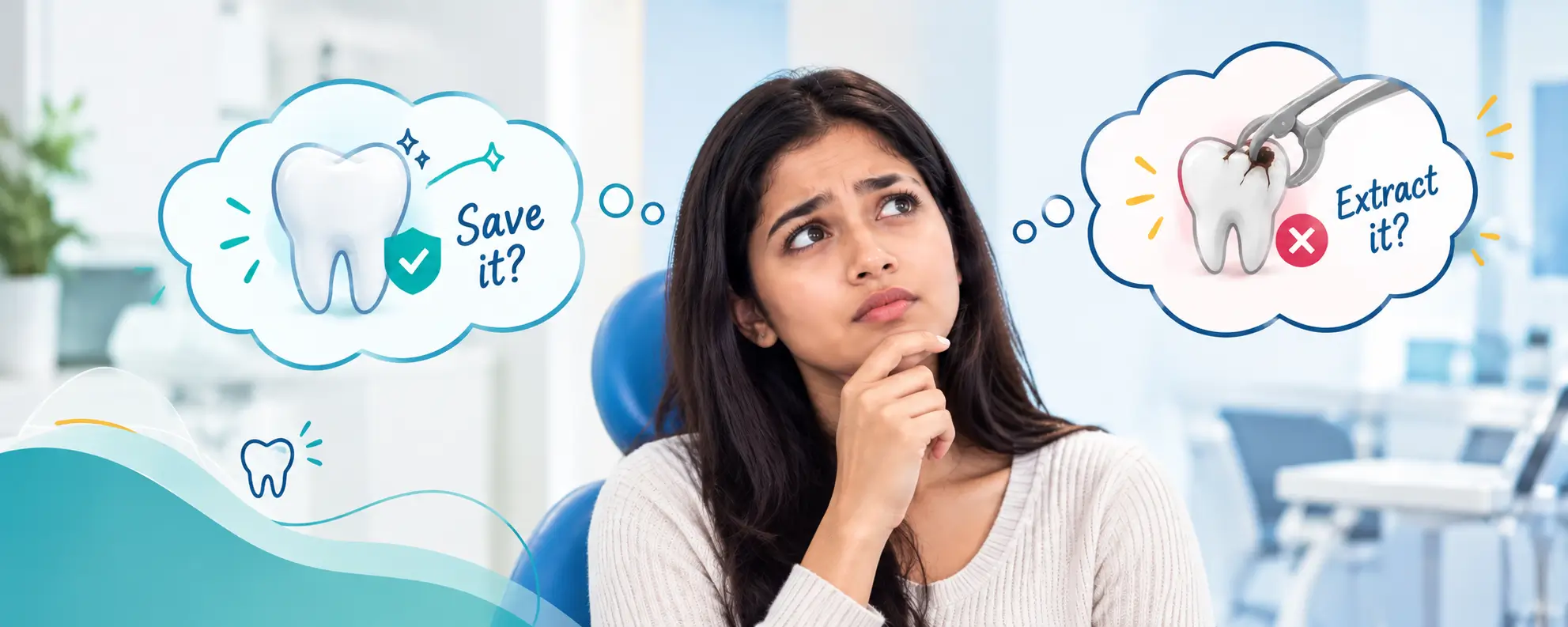
When a dentist tells you that a tooth is badly damaged, one of the first questions you may ask is:
Can the tooth be saved?
In many cases, there can be more than one treatment option. Depending on the condition of the tooth, treatment may involve a filling, crown, inlay or onlay, root canal treatment, or another restorative approach.
However, not every tooth can be saved.
The key is to understand what is happening inside and around the tooth before deciding between keeping it and removing it.
Why a tooth might need extraction?
A tooth may become difficult or impossible to restore because of extensive decay, severe fracture, infection, advanced gum disease or a lack of sufficient healthy tooth structure.
Extraction can sometimes be the safest option when keeping the tooth would result in an unreliable outcome. However, the fact that a tooth looks badly damaged does not automatically mean extraction is the only choice.
A dentist needs to assess the remaining tooth structure, the roots, the surrounding bone and gums, the bite, and the overall condition of the mouth.
When can a damaged tooth potentially be saved?
A tooth may still be restorable when enough healthy tooth structure remains to support treatment.
For example, depending on the condition of the tooth:
- A filling may be appropriate for a smaller area of decay or damage.
- An inlay or onlay may be considered when a tooth needs more support than a filling can provide but does not require a full crown.
- A crown may be appropriate when a tooth has suffered substantial structural damage and needs protection.
- Root canal treatment may be needed when infection or inflammation has affected the pulp inside the tooth.
The treatment depends on what is actually happening rather than the appearance of the tooth alone.
What does root canal treatment have to do with saving a tooth?
Root canal treatment is one of the main ways a dentist can attempt to preserve a tooth that has become infected or badly inflamed.
Instead of removing the entire tooth, the infected or damaged tissue inside the tooth is treated, allowing the remaining tooth structure to be restored.
Whether a root canal-treated tooth can be restored successfully depends on the condition of the tooth and the amount of healthy structure remaining.
Does a tooth always need a crown after root canal treatment?
No.
This is an important point because patients sometimes assume that root canal treatment automatically means a crown.
In reality, the decision depends on factors such as the tooth type, how much structure remains, how much damage has occurred and the amount of functional stress placed on the tooth.
Some teeth may need additional protection after root canal treatment, while others may be suitable for a more conservative restoration.
This is one reason a clinical assessment matters.
What if there is a large filling already?
A heavily restored tooth can sometimes become more difficult to repair because less natural tooth structure remains.
In some situations, replacing another filling may be enough. In others, the dentist may recommend a crown, inlay or onlay to provide greater support.
The decision should be based on the condition of the tooth rather than simply the size of the old filling.
Can a broken tooth still be saved?
Sometimes.
A broken tooth may be repairable with a filling, crown or other restorative treatment depending on how far the fracture extends. Treatment for a broken or cracked tooth can include a filling, a crown or root canal treatment where the nerve is exposed.
The location of the fracture matters.
A small chip near the edge of a tooth is very different from a fracture that extends deeply through the tooth.
That is why treatment recommendations can differ greatly between patients who appear to have similar damage.
When is extraction more likely to be recommended?
Extraction may become necessary when a tooth cannot be predictably restored.
Examples can include situations where:
- There is extensive damage below the gum line
- The tooth has an unfavourable fracture
- There is insufficient healthy structure remaining
- The surrounding support is severely compromised
- Repeated restorative treatment is unlikely to provide a stable outcome
If extraction is recommended, it is reasonable to ask why the tooth cannot be restored and what alternatives have been considered.
What happens if the tooth is extracted?
If a tooth cannot be saved and must be removed, the next discussion is often about whether the missing tooth should be replaced.
Depending on the individual situation, options may include:
- Dental implants
- Dental bridges
- Dentures
- In some cases, leaving the space
Missing teeth can be replaced with bridges, dentures or dental implants, and that the most suitable choice depends on the individual situation.
A dental implant, for example, replaces the root portion of a missing tooth and can support a crown, bridge or denture.
Should you ask for a second opinion?
When the recommended treatment involves extracting a tooth, it is reasonable to ask questions before proceeding.
You may want to understand:
- Why is the tooth considered non-restorable?
- Could root canal treatment help?
- Would a filling, inlay, onlay or crown be possible?
- What are the risks of trying to save the tooth?
- What happens if the tooth is left untreated?
- What would replace the tooth if extraction becomes necessary?
A dentist should explain the reasoning behind the recommendation so that you can make an informed decision.
Saving the natural tooth is not always the goal
Preserving a natural tooth can be desirable, but saving a tooth at any cost is not always the best treatment.
A poorly positioned or severely compromised tooth may have a poor long-term outlook even after extensive treatment.
The aim is to reach a predictable, healthy, and functional result.
That means sometimes saving the tooth is the best choice and sometimes removing it and planning a suitable replacement is more appropriate.
The first step is an assessment
If you have been told that a tooth may need extraction, do not make the decision based only on the visible damage.
A proper examination can help establish whether the tooth is restorable and what treatment options are available.
Walton Dental Surgery provides restorative and replacement treatment options including crowns, bridges, dentures and dental implants. The practice is located at 71A Hersham Road, Walton-on-Thames.